
The Admissions Journey.
It begins with a conversation. Admissions at Ardee Montessori Houses open each year from November to March. We welcome families who share our belief in purposeful, child-centred Montessori education and are looking to become part of the Ardee community.
Seven steps, from enquiry to welcome.
The steps below are those set out in Ardee Montessori Houses prospectus.
Enquiry form
Complete the enquiry form on the Contact and Visit page. Our team responds within 24 hours, Monday to Friday.
School Tour - Virtual and Physical
Families are invited to see the environments for themselves, online through the virtual tour and in person at the House.
Application form
Submit the application form along with the required documents.
Interaction with the Head of School
A conversation between the family and the Senior Leadership Team of the House.
Offer letter
Once the interaction process is complete, an offer letter is shared with the parents.
Payment of fees
Admission is confirmed upon payment of the fees.
Welcome to Ardee Montessori House
Families receive the child’s Structure of the Day and orientation information, marking the beginning of their child’s journey at Ardee.
Apply for 2026–27
We welcome applications for Nido through the Early Years Foundation Stage (EYFS), within an environment rooted in authentic Montessori practice. Applications for 2026–27 are now open. Complete the enquiry form to begin the process. Our Admissions Team will be in touch within 24 hours to schedule a visit.
Register your interest, and we will respond within 24 hours.
Seats are available across NIDO, Red, Blue and EYFS. Early enquiries are encouraged, as seats are limited.
The Admissions Office is available Monday to Friday, 8:00 AM to 4:00 PM.
18001027333 (180010ARDEE)
contactusmunirka@ardeemontessorihouse.com
Timings by Environment
Each environment follows a carefully considered Structure of the Day, designed to meet the developmental needs of each stage while protecting the long, uninterrupted periods of concentration essential to Montessori work.
Dressed for the Day
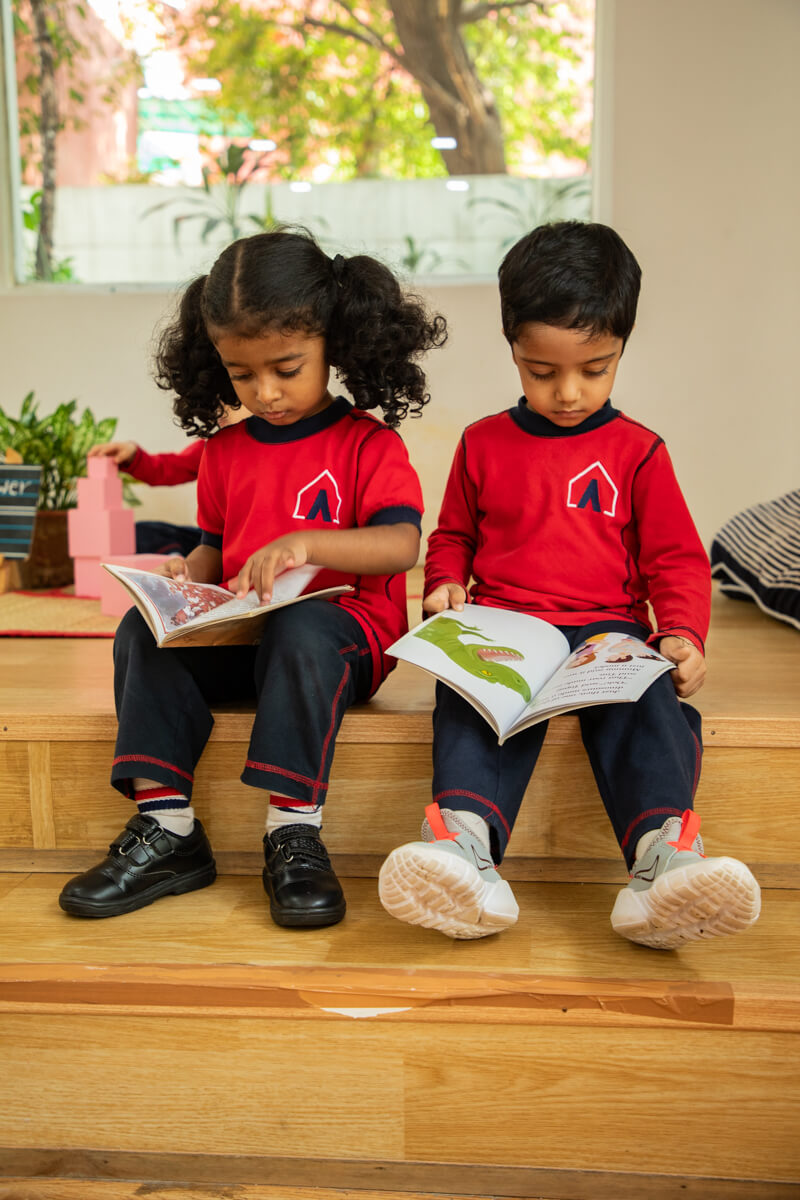
The Ardee uniform reflects the character of the House. Ardee Blue and Ardee Red embody its guiding principles — balance and harmony, purpose and commitment, knowledge and integrity.
Children, mentors, and staff wear the prescribed uniform each day, fostering a shared sense of community, equality, and pride in belonging to the House.
 3 photos
 3 photos
 2 photos
 3 photos
Term Dates & Key Events
The House year runs in four terms, with breaks in between. Dates for orientation, parent conferences and portfolio reviews are set accordingly, and are shared with families at the beginning of the year.The full calendar is available on the parent communication app, and a printed copy is provided at the beginning of the academic year.
| Period | Dates | Notes |
|---|---|---|
| Term 1 | July – Sept | House year opens. New family orientation. |
| Mid-Term Break | October | House closed. Individual dates shared with families. |
| Term 2 | Oct – Dec | Includes first parent–mentor conferences. |
| Winter Break | Late Dec – Early Jan | House closed. |
| Term 3 | Jan – March | Observation-based portfolio review. |
| Spring Break | March – April | House closed. |
| Term 4 | April – June | Year-end review; transition planning for children moving to Cambridge Primary. |
| Summer Break | June – July | House year ends. |
Dates may vary from year to year. Please refer to the official calendar shared with families at the start of the year, or contact the Admissions Office for confirmation.
Submit the application form together with the documents listed below..
The documents below follow the list used across the Ardee Schools; those marked for confirmation may not apply to the youngest children.
Your questions answered.
How is Montessori different from a conventional preschool?
The Montessori approach is centred on the individual child and their natural development. Children learn through purposeful, hands-on experiences in a carefully prepared environment, rather than following a uniform pace or approach. They are encouraged to make meaningful choices, develop concentration and independence, and learn through exploration and repetition. Mentors observe each child closely and provide guidance based on their individual developmental needs.This approach supports the child’s cognitive, physical, social and emotional development, while building strong foundations for lifelong learning.
What does a typical day in the Montessori environment look like?
A typical day is thoughtfully structured while allowing children the freedom to engage with the environment at their own pace. Children have opportunities for uninterrupted work, movement, group interactions, outdoor experiences, meals and rest, depending on their age and environment. The day is designed to support independence, concentration, social development and joy in learning.
How much freedom does my child have in the classroom?
Children have the freedom to choose their work, move within the environment and work at their own pace, within clearly established boundaries. The environment is carefully prepared so that children can make meaningful choices while developing responsibility and respect for themselves, others and their surroundings.
Does freedom mean children can do whatever they want?
In Montessori, freedom comes with responsibility. Children are free to make choices within clear and consistent boundaries. They learn to respect the environment, care for materials, consider others and understand that their choices have consequences. This balance between freedom and responsibility helps children develop self-discipline and independence.
Are meals provided at school?
Yes. We provide wholesome, nutritious and thoughtfully planned meals for children at school, supporting their well-being and healthy development.
How do you encourage independence in young children?
Independence is built into everyday experiences. Children are encouraged to do things for themselves—from choosing and completing their work to carrying their belongings, serving themselves during meals, putting materials back after use and taking care of their personal space. Mentors provide guidance when needed, while allowing children the time and opportunity to try independently.
Why do children repeat the same activity several times?
Repetition is an important part of Montessori learning. When children repeat an activity, they are not simply doing the same thing again—they are refining their movements, strengthening concentration, building confidence and deepening their understanding. Repetition allows a child to move from “I can try” to “I can do it independently.”
How long does it usually take for a child to settle?
Every child is unique, and there is no fixed timeline for settling into a new environment. Some children become comfortable within a few days, while others may need several weeks. We focus on building trust and creating a sense of security rather than rushing the process. Consistency between home and school, along with a calm and reassuring approach, can greatly support the transition.
Which Environment do the children transition to after Nido?
After Nido, children transition into the Early Red Environment, where they continue to build on the foundations developed during their Nido experience. The transition is gradual and responsive to each child’s developmental readiness. As children grow, they progress through the Montessori environments, with increasing opportunities for independence, concentration and purposeful learning.
What are the Red and Blue Environments?
The Red Environment is Pre-Nursery and the Blue Environment is Nursery. Both are thoughtfully prepared Montessori environments designed to meet the developmental needs of children at different stages. Each environment offers age-appropriate experiences that support children in developing independence, concentration, language, early mathematical thinking, sensorial awareness, movement and social skills. As children grow, the environment and learning experiences evolve with them, gradually becoming more complex while continuing to be rooted in hands-on exploration, purposeful activity and real-life experiences.
How do you support children who need more time to adjust?
We recognise that every child has a unique temperament and pace of adjustment. Mentors observe the child closely, build a trusting relationship and provide reassurance without putting pressure on the child to participate before they are ready. We work closely with parents to understand the child and maintain consistency between home and school. Our aim is to help each child gradually develop a sense of belonging, security and confidence.
What will my child learn in Pre-Primary?
The Montessori environment at Ardee Montessori House aims to nurture the whole child, focusing on much more than academic readiness. It supports children’s development across language, early literacy, mathematical thinking, physical development, practical life skills and social-emotional growth. Through meaningful experiences and everyday interactions, children develop confidence, independence, concentration, problem-solving skills and the ability to make thoughtful choices. The focus is on helping children become secure, confident, curious and capable learners who are ready to engage with the world around them.
When do children start reading and writing?
Montessori follows the child’s developmental readiness rather than rushing the process. Children are first given rich experiences in language, sound awareness, vocabulary, fine-motor development and communication. As their readiness develops, they are introduced to reading and writing through carefully sequenced Montessori materials and experiences in the environment.
How do you introduce numbers and mathematics?
Mathematics is introduced through concrete, scientifically designed Montessori materials that enable children to explore mathematical concepts through hands-on experiences. Children develop an understanding of quantity, number, patterns and relationships before gradually progressing towards more abstract mathematical thinking. This approach helps children develop a deep conceptual understanding of mathematics, rather than relying solely on rote learning.
Does my child need to be toilet trained before joining?
Toilet readiness varies from child to child and depends on their age and stage of development. We encourage families to begin building awareness and independence around toileting at home, but children are not expected to master the process overnight. Our mentors support children respectfully and consistently as they develop these skills.
How do you encourage children to manage their own belongings?
Children are encouraged to take responsibility for their belongings from an early age. They learn to identify, carry and organise their personal items, put things back in their designated spaces and care for the materials and environment around them. These small everyday responsibilities help children develop organisation, ownership and independence.
Ready to begin?
Enquire, book a tour, or speak to the Admissions Office.